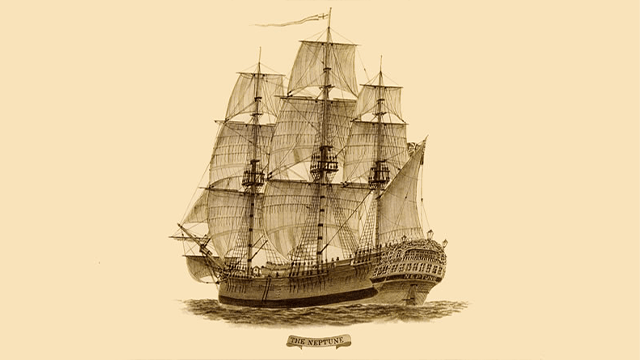
The Neptune convict ship - Image Wikimedia Commons
In this pre-submission seminar, Nichola Garvey presents her thesis research on a group biographical study of the women transported on the Second Fleet vessel Neptune. It asks a deceptively simple question: how did these women survive? It examines survival on both the Neptune voyage, which recorded the highest mortality rate of any transport ship in Australian history, and survival in an early colony marked by starvation, weak infrastructure, and a severe gender imbalance that placed women in particularly vulnerable positions.
The findings challenge enduring narratives that portray convict women as either helpless victims or moral degenerates and expand on revisionist history that situate women as unrecognised contributors to nation building. Throughout this thesis, Neptune women emerge as skilled economic actors operating within what this thesis conceptualises as a “makeshift economy”: a largely informal system of exchange that had long sustained poor and working-class women in late eighteenth-century England. Central to this economy was the second-hand clothing trade, in which garments functioned as both commodity and currency, enabling participation in networks of exchange, credit, and subsistence largely invisible to formal records.
Transportation dismantled the market conditions that made clothing valuable as currency, yet the underlying skills, including strategic flexibility, willingness to operate in legal and moral grey zones, and the ability to leverage limited assets, proved transferable. Using mixed biographical methods combining intensive individual case reconstruction with prosopographical analysis of the entire Neptune cohort, the thesis traces how women adapted makeshift strategies to colonial conditions, progressing from barter and sexual economies to sophisticated credit networks and, ultimately, land ownership.
Prosopographical analysis demonstrates that land access was the decisive structural determinant separating precarious survival from prosperity and longevity. Women who secured land lived on average fifteen years longer than those who did not. By reconstructing informal economic activity through fragmentary archival traces, this study reframes early colonial economic life, positioning convict women as active economic agents whose strategies shaped colonial markets and demonstrating how those strategies were deployed for demographic resilience.
Nichola Garvey is a PhD candidate at the National Centre of Biography in the School of History at the Australian National University. She is an experienced writer with a background in published biography and corporate history. Her doctoral research examines convict women’s economic agency, survival strategies, and gendered participation in informal and makeshift economies in early colonial New South Wales. Through intensive biographical and prosopographical methods, her work recovers the lived economic practices of women whose activities were central to colonial development but have remained largely invisible in both contemporary records and later historiography. Alongside her academic research, she balances professional writing, family life, and the management of a family business.
Join Zoom Meeting: https://anu.zoom.us/j/88902124291?pwd=f9S8I7GgtJwog6OkB0E3BQTxq77WdN.1
Meeting ID: 889 0212 4291
Password: 814181
Location
Speakers
- Nichola Garvey, Australian National University (Pre-submission seminar)
Contact
- Ruby Ekkel